Last time
More on floating point
Discuss Taylor Series activity
Condition numbers
Today
Intro to forward and backward error
Computing volume of a polygon
Rootfinding
Bisection Method
using Plots
default(linewidth=4)
What we’re hoping for is for our problems (functions) and algorithms to be reliable (i.e., we can trust the result that our computer spits out). Reliable = well-conditioned and stable. But unfortunately
Mathematical functions can be ill-conditioned: (big )
Modeling is how we turn an abstract question into a mathematical function
We want well-conditioned models (small )
Some systems are intrinsically sensitive: fracture, chaotic systems, combustion
Algorithms f(x) can be unstable
Unreliable, though sometimes practical
Unstable algorithms are constructed from ill-conditioned parts
1. Introduction to forward and backward error
Activity: Read Backward error
Backward error measures what change to the original data would reproduce the result found by an algorithm.
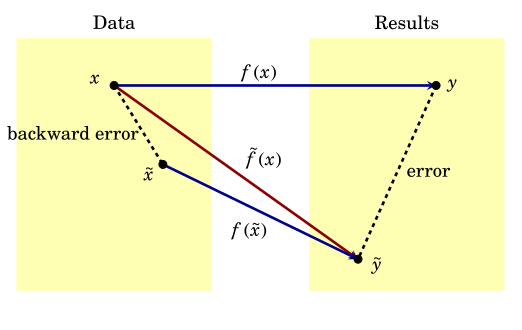
Let be a computed result for the original data . If there is a value such that
then we call the (relative) backward error of the result.
Instead of asking, “How close to the true answer is your answer?”, backward error asks, “How close to the true question is the question you answered?”
For ill-conditioned functions, the best we can hope for is small backward error.
If an algorithm always produces small backward errors, then it is stable. But the converse is not always true: some stable algorithms may produce a large backward error.
Exercise 11.1
Find a function that models something you’re interested in
Plot its condition number as a function of
Plot the relative error (using single or double precision; compare using Julia’s
big)Is the relative error ever much bigger than ?
If so, can you find what caused the instability in your algorithm?
Further reading: FNC Introduction
2. Stability demo: Volume of a polygon
Activity: run the following code and comment on the result
X = [1 0; 2 1; 1 3; 0 1; -1 1.5; -2 -1; .5 -2; 1 0]
R(θ) = [cos(θ) -sin(θ); sin(θ) cos(θ)] # rotation matrix
Y = X * R(deg2rad(30))' .+ [0 0]
plot(Y[:,1], Y[:,2], seriestype=:shape, aspect_ratio=:equal, xlims=(-3, 3), ylims=(-3, 3))using LinearAlgebra
function pvolume(X)
n = size(X, 1)
vol = sum(det(X[i:i+1, :]) / 2 for i in 1:n-1)
end
@show ref_vol = pvolume(X)
@show rotated_vol = pvolume(Y)ref_vol = pvolume(X) = 9.25
rotated_vol = pvolume(Y) = 9.25
9.25What happens if this polygon is translated, perhaps far away? (We’ll see more next time)
3. Rootfinding
Given , find such that .
We’ll work with scalars ( and are just numbers) for now, but keep in mind that they can be vector-valued.
We aren’t given , but rather an algorithm f(x) that approximates it.
Sometimes we get extra information, like
fprime(x)that approximatesIf we have source code for
f(x), maybe it can be transformed “automatically” to obtainfprime(x)
Example: Queueing
In a simple queueing model, there is an arrival rate and a departure (serving) rate. While waiting in the queue, there is a probability of “dropping out”. The length of the queue in this model is
One model for the waiting time (where these rates are taken from exponential distributions) is
wait(arrival, departure) = log(arrival / departure) / departure

plot(d -> wait(1, d), xlims=(.1, 1), xlabel="departure", ylabel="wait", label = "wait")Departure rate given wait
Easy to measure wait
I have a limited tolerance for waiting
my_wait = 0.8
plot([d -> wait(1, d) - my_wait, d -> 0], xlims=(.1, 1), xlabel="departure", ylabel="wait")import Pkg; Pkg.add("Roots")
using Roots
d0 = find_zero(d -> wait(1, d) - my_wait, 1)
plot([d -> wait(1, d) - my_wait, d -> 0], xlims=(.1, 1), xlabel="departure", ylabel="wait")
scatter!([d0], [0], marker=:circle, color=:black, title="d0 = $d0") Project No packages added to or removed from `~/.julia/environments/v1.13/Project.toml`
Manifest No packages added to or removed from `~/.julia/environments/v1.13/Manifest.toml`
4. Bisection Method
Bisection is a rootfinding technique that starts with an interval containing a root and does not require derivatives. Suppose is continuous. What is a sufficient condition for to have a root on ?
Hint: Intermediate value theorem and its corollary, Bolzano’s theorem.
hasroot(f, a, b) = f(a) * f(b) < 0

f(x) = cos(x) - x
plot(f, label = "cos(x) - x")Bisection Algorithm: a recursive algorithm
function bisect(f, a, b, tol)
    mid = (a + b) / 2
    if abs(b - a) < tol
        return mid
    elseif hasroot(f, a, mid)
        return bisect(f, a, mid, tol)
    else
        return bisect(f, mid, b, tol)
    end
end

x0 = bisect(f, -1, 3, 1e-5)
x0
0.7390861511230469# is it really a root? Let's check:
f(x0)-1.7035832658995886e-6How fast does it converge?
Let’s look at how many iterations it took to find the root.
function bisect_hist(f, a, b, tol)
    mid = (a + b) / 2
    if abs(b - a) < tol
        return [mid]
    elseif hasroot(f, a, mid)
        return prepend!(bisect_hist(f, a, mid, tol), [mid])
    else
        return prepend!(bisect_hist(f, mid, b, tol), [mid])
    end
end
bisect_hist (generic function with 1 method)bisect_hist(f, -1, 3, 1e-4)17-element Vector{Float64}:
1.0
0.0
0.5
0.75
0.625
0.6875
0.71875
0.734375
0.7421875
0.73828125
0.740234375
0.7392578125
0.73876953125
0.739013671875
0.7391357421875
0.73907470703125
0.739105224609375Iterative bisection: an optimized algorithm
Data structures are often optimized for appending rather than prepending.
Saves stack space
function bisect_iter(f, a, b, tol)
    hist = Float64[]
    while abs(b - a) > tol
        mid = (a + b) / 2
        push!(hist, mid)
        if hasroot(f, a, mid)
            b = mid
        else
            a = mid
        end
    end
    hist
end
bisect_iter (generic function with 1 method)bisect_iter(f, -1, 3, 1e-4)16-element Vector{Float64}:
1.0
0.0
0.5
0.75
0.625
0.6875
0.71875
0.734375
0.7421875
0.73828125
0.740234375
0.7392578125
0.73876953125
0.739013671875
0.7391357421875
0.73907470703125r = bisect(f, -1, 3, 1e-14) # what are we trusting?
hist = bisect_hist(f, -1, 3, 1e-10)
scatter( abs.(hist .- r), yscale=:log10)
ks = 1:length(hist)
plot!(ks, 4 * (.5 .^ ks))Evidently the error after bisection iterations satisfies the bound
The absolute error is halved at each step so the method converges linearly. But is this all there is to it? We’ll see more next time.
Exercise 11.3
Find an interval of length 1 with integer endpoints on which a solution to lies. Then use the bisection code starting with this interval to find the solution within a 10-4 tolerance.
Find an interval of length 1 with integer endpoints on which a solution to lies. Then use the bisection code starting with this interval to find the solution within a 10-4 tolerance.
Suppose we want to know what interest rate we would need to achieve (assuming constant interest rates) such that the initial deposit of and annual contribution of will grow to in 20 years. Thus we need to solve for the interest rate, . Find a reasonable interval on which the solution ought to lie and use the bisection code to find to within 10-6.
Find appropriate intervals and use the bisection code to find ALL the root(s) of .
Use the bisection code to find the root of on to within 10-6.
Use the bisection code to find the root of on to within 10-6.