Last time
Newton’s method
Convergence of fixed-point method
Different formulation of Newton’s method
Today
Forward and backward stability
Lax equivalence theorem
Recap and Q/A
using Plots
default(linewidth=4, legendfontsize=12)
1. Stability
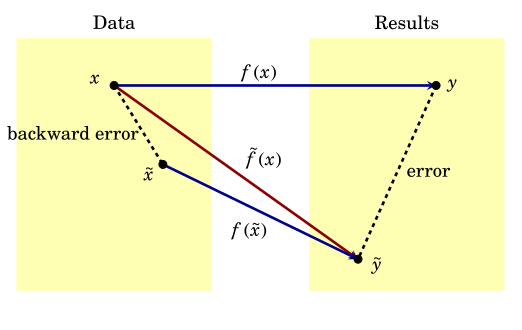
Source: FNC: backward error
(Forward) Stability
“nearly the right answer to nearly the right question”
for some that is close to
Backward Stability
“exactly the right answer to nearly the right question”
for some that is close to
Note:
Every backward stable algorithm is () stable.
Not every stable algorithm is backward stable.
The difference is in the focus: forward analysis is concerned with what the method reaches, while backward analysis looks at the problem being solved (which is why we can speak of ill-conditioned methods and ill-conditioned problems).
In a backward stable algorithm the errors introduced during the algorithm have the same effect as a small perturbation in the data.
If the backward error is the same size as any uncertainty in the data then the algorithm produces as good a result as we can expect.
Accuracy of backward stable algorithms (Theorem)
A backward stable algorithm for computing has relative accuracy
Backward stability is generally the best we can hope for.
In practice, it is rarely possible for a function to be backward stable when the output space is higher dimensional than the input space.
2. Lax equivalence theorem
Consistency: describes how well the numerical scheme aproximates the PDE (if the Finite Difference (FD) discretization is at least of order 1 it is consistent --- The residual reduces under grid refinement). We will see FD in more details when we cover numerical differentiation.
Stability: Numerical stability concerns how errors introduced during the execution of an algorithm affect the result. It is a property of an algorithm rather than the problem being solved (check Higham’s blog again). This gets subtle for problems like incompressible materials or contact mechanics.
Convergence: When the solution of the approximated equation approaches the actual solution of the continuous equation.
Consistency + Convergence Stability
Consistency + Stability Convergence
Hence,
Lax equivalence theorem: Consistency + Convergence Stability
3. Recap and Q/A
All good, but in praxtice?
These are foundational theoretical tools, and can often be tested in practice, but
it doesn’t establish that the code works
it’s not possible to prove convergence for many real-world problems
there are open research questions about whether numerous important problems are even well-posed
Empirical measurement of convergence
Convergence on a problem with an analytical solution:
These can be great, but analytical solutions of nonlinear equations are extremely hard to find.
Such solutions usually have many symmetries and rarely activate all terms.
Self-convergence:
Just set up a problem and solve it on a sequence of meshes, use a refined solution as reference (perhaps using Richardson extrapolation), then plot error.
You’ve checked that the code convergences to some solution, not the correct solution. (You could have a factor of 2 typo, or more serious mistakes.)
Method of Manufactured Solutions (MMS):
Errors that affect solution accuracy can easily be detected.
There are some technical issues with singular or under-resolved problems (shocks, material discontinuities).